From 12 February 2024, most development in England became subject to a mandatory biodiversity net gain requirement. The measure, introduced through the Environment Act 2021 and brought into force by secondary legislation in January 2024, requires developers to demonstrate that any development project leaves biodiversity at least 10% better off than it was before construction began. It is one of the most significant changes to English planning law in a generation, and one that has generated substantial confusion about what it requires in practice, how the 10% gain is measured, and what happens when on-site habitat creation is insufficient to meet the threshold.
The policy context is stark. Natural England’s State of Nature Report 2023, produced with the Royal Society for the Protection of Birds and over 60 other organisations, found that 15% of species in Great Britain are at risk of extinction, and that wildlife habitats have declined in both extent and quality since the 1970s. Development has historically been one driver of that decline; the biodiversity net gain requirement is an attempt to reverse the relationship between planning consent and ecological loss.
What the 10% Gain Requirement Means
The biodiversity net gain requirement is not a simple instruction to add more green space to a development. It is a quantified ecological obligation measured using a standardised calculation tool called Biodiversity Metric 4.0, developed by Natural England.
Biodiversity Metric 4.0 assigns a value to different habitat types based on their area, quality, distinctiveness, and spatial context. A lowland meadow in good condition scores higher than an improved grassland in moderate condition. Ancient woodland scores higher than a recently planted plantation. The metric produces a ‘biodiversity unit’ score for the pre-development site baseline and a projected score for the post-development condition. The developer must demonstrate that the post-development score is at least 10% higher than the baseline.
The 10% target is a floor, not a ceiling. Local planning authorities can require higher gains for developments in ecologically sensitive areas. The National Planning Policy Framework, updated in December 2023, includes biodiversity net gain as a material consideration in all planning decisions. Developments that can demonstrate gains significantly above 10% may find those gains weigh favourably in planning balance assessments for otherwise marginal proposals.
Who the Requirement Applies To
The mandatory requirement applies to most development falling under the Town and Country Planning Act 1990, subject to exemptions. Large sites were brought in first, from 12 February 2024. Small sites, defined as those with less than 10 dwellings or less than 0.5 hectares of development area, were brought in from 2 April 2024. Nationally Significant Infrastructure Projects, including major transport, energy, and water infrastructure, are subject to a separate BNG requirement under the Infrastructure Act framework, with implementation timescales being set separately.
Exemptions apply to certain categories, including developments below de minimis thresholds for habitat impact, householder applications for extensions to existing homes, self-build and custom build developments of a single dwelling, urgent infrastructure works, and permitted development. Local authorities can also grant exemptions for phased developments where the biodiversity metric cannot meaningfully be calculated for individual phases.
The requirement applies to the planning authority for the area where the development is located. London boroughs, combined authority areas, and national park authorities all have planning authority status and are responsible for enforcing the BNG requirement within their areas.
How Developers Can Deliver the Gain
The biodiversity net gain hierarchy runs from on-site delivery to off-site delivery to statutory biodiversity credits, and developers are expected to follow the hierarchy in that order.
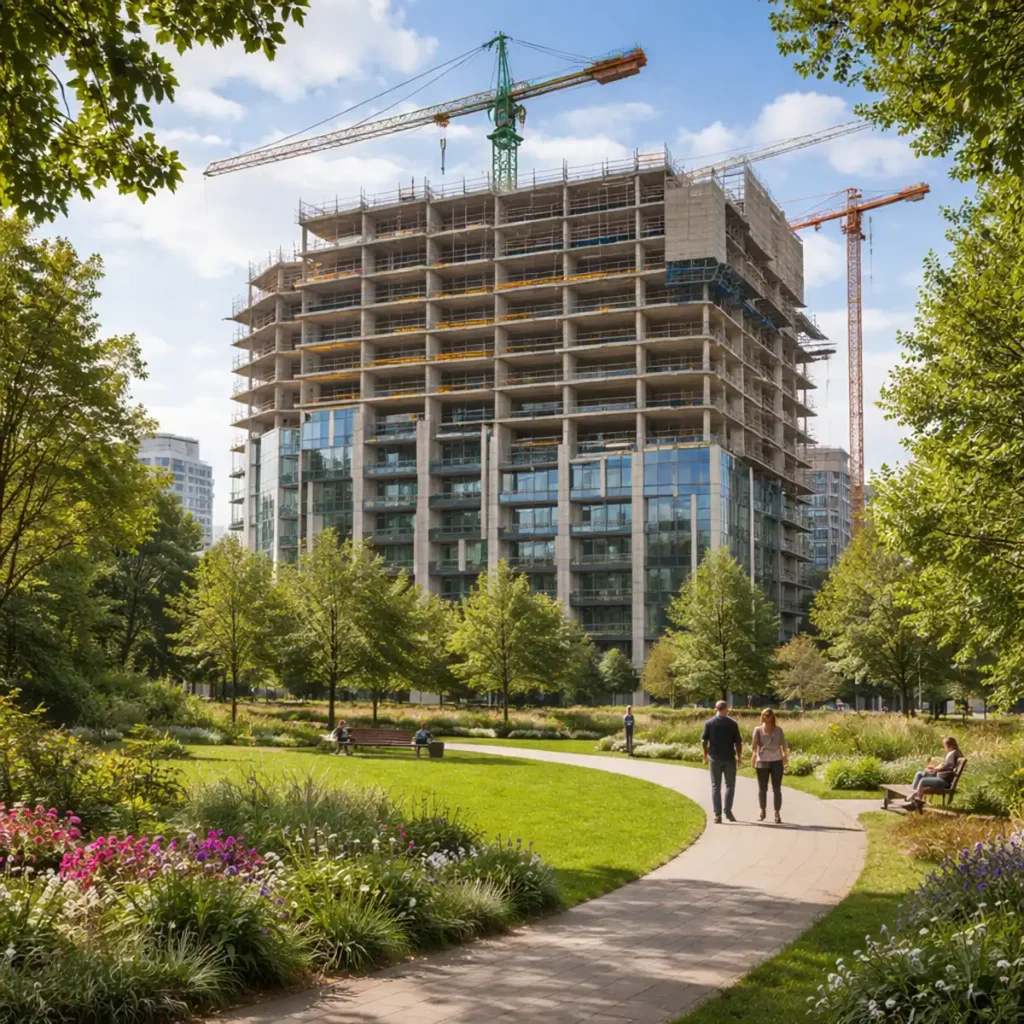
On-site delivery is the preferred route. Where a development site has sufficient space and ecological potential, the developer creates or enhances habitats within the site boundary to meet the required net gain. This might mean retaining or enhancing existing hedgerows, creating new woodland or wildflower meadow areas, or designing the development’s green infrastructure to maximise habitat quality. On-site delivery keeps the ecological benefit close to the development impact and is generally lower cost than off-site alternatives.
Off-site delivery is permitted where on-site gain is insufficient, subject to planning authority approval. Developers can purchase ‘biodiversity units’ from off-site habitat creation or enhancement projects. These projects must be registered on the national biodiversity gain site register maintained by Natural England, must meet minimum habitat quality standards, and must be secured by a legal agreement (typically a Section 106 obligation or conservation covenant) for at least 30 years. The off-site habitat must generally be within the same local nature recovery strategy area as the development to preserve spatial relevance.

Statutory biodiversity credits are the last-resort mechanism. Where neither on-site nor off-site delivery can meet the required gain, developers can purchase government-sold credits from Natural England. The credit price is deliberately set above the market rate for off-site BNG units to incentivise the use of private markets first. Credit prices are reviewed periodically; the initial prices were set at levels that made statutory credits substantially more expensive than off-site habitat banking.
The 30-Year Maintenance Obligation
One of the most significant compliance implications of biodiversity net gain is the 30-year habitat management and monitoring obligation. The biodiversity gain objective secured by a planning condition or Section 106 agreement must be maintained for at least 30 years from the point at which the habitat is created or enhanced. This is not a passive obligation; it requires active management to prevent succession to scrub or woodland where other habitat types are the target, and monitoring to verify that the habitat quality assumed in the metric calculation is being achieved.
The 30-year obligation runs with the land, not with the developer. A developer who sells a completed residential development transfers the BNG management obligation to the landowner or management company that takes on the site’s green infrastructure. This has significant implications for the management of estate and apartment building service charges, for the responsibilities of residents’ management companies, and for the due diligence required when purchasing land that has a live BNG obligation attached.
Local planning authorities have limited resources for 30-year BNG monitoring. The Chartered Institute of Ecology and Environmental Management (CIEEM) has raised concerns that under-resourced planning departments will struggle to enforce management obligations at the scale the mandatory requirement generates. Natural England’s national register of biodiversity gain sites is the primary audit trail, but enforcement of on-site obligations depends on local authority capacity.
Fun fact: The concept of biodiversity net gain as a formal planning policy was first tested in England through voluntary pilot schemes from 2019. Natural England developed the Biodiversity Metric specifically to make ecological value quantifiable in a way that non-ecologists (including planners, developers, and lawyers) could apply consistently, replacing the qualitative judgements that had previously characterised ecological impact assessment.
What the Requirement Means for UK Nature Recovery
The biodiversity net gain requirement is part of a wider legislative architecture for nature recovery in England that includes the Local Nature Recovery Strategies being developed by county and combined authorities under the Environment Act 2021, the Species Conservation Strategies being led by Natural England, and the government’s commitment to the Global Biodiversity Framework target of protecting or conserving 30% of UK land and sea by 2030 (the ’30×30′ target).
Whether the mandatory BNG requirement, combined with the voluntary BNG market and the Environmental Land Management scheme payments to farmers, is sufficient to reverse the species loss trends documented in the 2023 State of Nature Report is a question that the ecological monitoring community will be assessing over the next decade. Early independent assessments, including a 2024 review by the Joint Nature Conservation Committee, found that the metric calculation methodology incentivises the creation of habitat types that are relatively easy to deliver and measure, such as grasslands, over habitat types that are ecologically more valuable but harder to create at scale, such as wetlands and ancient woodland. That incentive structure may mean that the aggregate gain in biodiversity units is not matched by an equivalent gain in ecological function.